
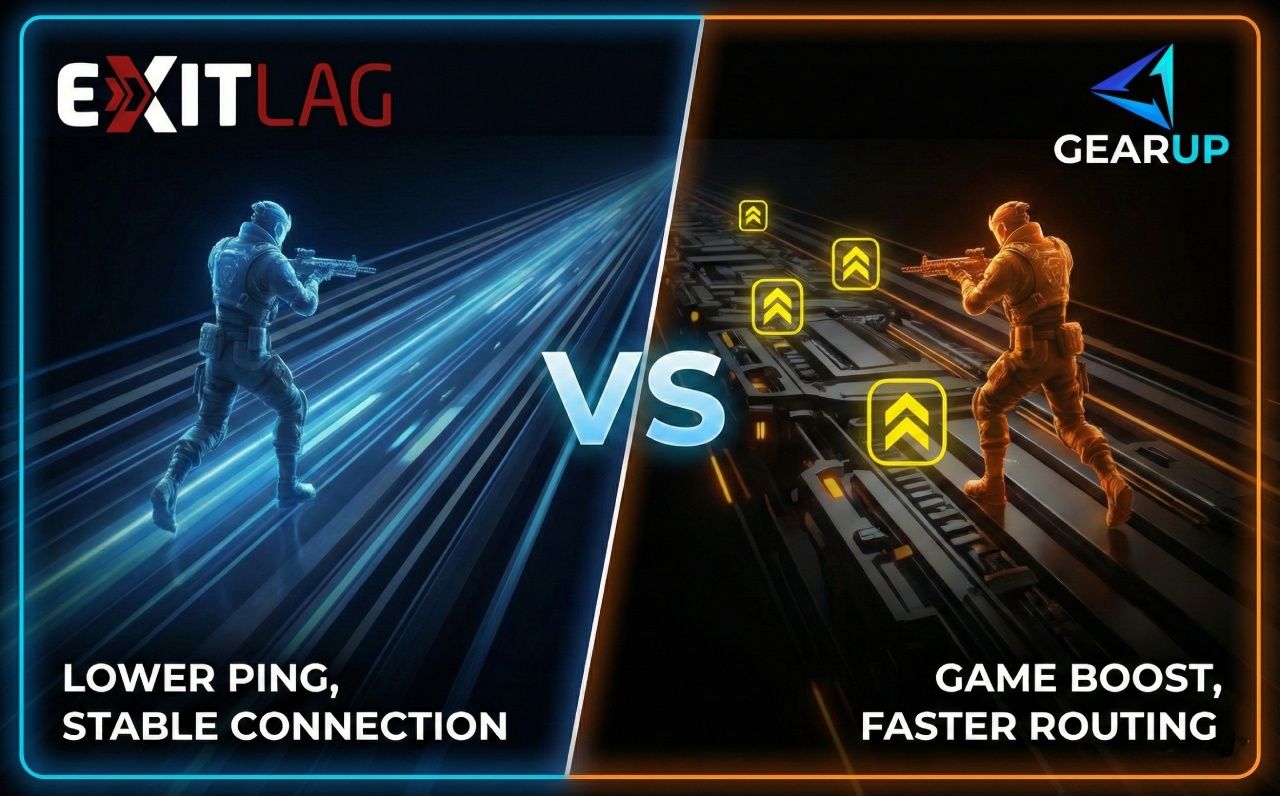
ExitLag and GearUP represent two leading gaming network optimization solutions designed to reduce ping, eliminate packet loss, and improve connection stability for competitive players. GearUP Booster supports over 1,000 games across mobile devices, PCs, and consoles, while ExitLag provides access to more than 200 global servers with multipath routing capabilities. ExitLag stands out by promising not just reduced ping but also improved frame rates (FPS), adding another layer to the decision-making process.
The choice between these optimization tools extends beyond simple ping reduction. Real-world performance varies significantly based on your geographic location, preferred games, and existing internet infrastructure. Both services employ different technical approaches to achieve latency improvements, with GearUP utilizing over 7,500 game-optimized nodes compared to ExitLag's approximately 500-node network.
This analysis examines performance metrics, pricing structures, and actual user testing results to determine which optimization tool delivers superior value for serious gamers seeking competitive advantages through network enhancement.
ExitLag vs GearUP: Which One is Better
The superior optimization tool depends entirely on your specific gaming setup and geographic location. GearUP's infrastructure advantage is substantial, operating over 7,500 game-optimized nodes across 180+ regions compared to ExitLag's approximately 500 nodes. This network size difference creates noticeable performance variations across different regions.
Game-specific performance reveals interesting patterns. FC 24 players consistently report better results with GearUP, while Call of Duty delivers comparable performance on both services. World of Warcraft players connecting from South America to European servers experienced stable 198ms ping through ExitLag versus 192-198ms with GearUP, though the 6ms difference proved meaningless during actual gameplay.
Regional testing shows mixed results for cross-continental connections. US players connecting to Asian servers report conflicting experiences - some prefer ExitLag's stability despite higher ping numbers, while others favor GearUP's lower latency despite occasional connection drops.
Platform compatibility creates a clear distinction between the services. GearUP extends functionality to PC, mobile, and console devices, making it the obvious choice for multi-platform gamers. ExitLag restricts console support significantly. Customer service quality varies considerably, with Trustpilot reviews highlighting ExitLag subscription cancelation difficulties.
The most effective approach involves testing both services during their free trial periods using your actual games and server connections. Performance differences often become apparent only through direct comparison in your specific gaming environment.
Performance Comparison: Ping, Latency, and Connection Stability
Both services tackle ping reduction through different technical approaches. GearUP employs Adaptive Intelligent Routing (AIR) with Smart Path Selection that analyzes thousands of global nodes to find the least congested routes. ExitLag uses proprietary multipath technology, sending data through multiple routes simultaneously and automatically switching if one path fails.
The effectiveness of ping reduction depends entirely on your ISP's default routing quality. Players with suboptimal ISP routes report ping drops of 30 to 60 percent, whereas users with already efficient connections see minimal changes. Testing from South America to European servers revealed ExitLag achieving 238ms to 198ms, while GearUP reached 192ms. Another user connecting to Asian servers reported reductions from 110ms to 68ms with GearUP.
Connection stability often proves more crucial than raw ping numbers for competitive gameplay. Both ExitLag and GearUP eliminate jitter by stabilizing latency spikes. One player experienced baseline ping of 180ms spiking to 300+ every few seconds without optimization, but achieved perfectly stable 160ms with routing tools. This consistency prevents rubber-banding and missed hit registration during crucial moments in competitive matches.
These services optimize routing paths rather than increasing your base internet speed. Neither compensates for severely limited bandwidth, outdated hardware, or poorly configured Wi-Fi setups.
Pricing and Subscription Plans
ExitLag structures its pricing around user capacity, offering three distinct subscription tiers. The Solo plan costs USD 9.99/month for single users, while the Duo plan drops to USD 7.91/month for two simultaneous connections, and the Squad plan provides the best value at USD 7.19/month supporting up to five users. Third-party resellers offer ExitLag subscriptions starting from USD 7.44 monthly, with extended subscription options priced at USD 21.99 for three months, USD 36.46 for six months, and USD 70.73 annually.
GearUP maintains a simpler pricing model with a standard monthly rate of USD 9.99. The platform offers in-app purchase options ranging from USD 2.49 to USD 55.99 based on platform and subscription duration. GearUP introduced its paid membership system in February 2022, providing monthly, quarterly, and annual subscription choices.
Both services include three-day free trials for performance testing before financial commitment. ExitLag's multi-user plans deliver superior value for teams sharing subscriptions across multiple devices or accounts. GearUP maintains consistent regional pricing, though auto-renewal charges process 12 hours before billing cycles in participating areas.
The most effective approach involves testing both services during their trial periods to determine which platform justifies ongoing subscription costs for your specific gaming requirements.
Comparison Table
The following breakdown compares key specifications and performance metrics between ExitLag and GearUP Booster across critical gaming optimization categories:
| Feature | ExitLag | GearUP Booster |
|---|---|---|
| Games Supported | Over 3,000 games | Over 3,000 games |
| Global Servers/Nodes | ~500 nodes, 200+ global servers | Over 7,500 game-optimized nodes |
| Regional Coverage | 200+ global servers | 180+ regions |
| Platform Support | PC, mobile and limited consoles | PC, mobile, and console devices |
| Key Technology | Proprietary multipath routing (multiple routes with automatic failover) | Adaptive Intelligent Routing (AIR) with Smart Path Selection |
| Ping Reduction | 238ms to 198ms (SA to EU example); 30–60% reduction | 192ms (SA to EU); 110ms to 68ms (to Asia); 30–60% reduction |
| Connection Stability | Eliminates jitter; stabilizes latency spikes; stable 160ms from 180ms baseline | Eliminates jitter and stabilizes latency spikes |
| Additional Features | Improved frame rates (FPS) | Not mentioned |
| Monthly Pricing (Solo) | USD 9.99/month | USD 9.99/month |
| Multi-User Plans | Duo: USD 7.91/month (2 users); Squad: USD 7.19/month (5 users) | Not mentioned |
| Extended Plans | 3 months: USD 21.99; 6 months: USD 36.46; Annual: USD 70.73 | Monthly, quarterly, and annual options available |
| Third-Party Pricing | Starting from USD 7.44/month | In-app purchases: USD 2.49 to USD 55.99 |
| Free Trial | 3 days | 3 days |
| Customer Service Notes | Some users report cancelation difficulties (Trustpilot reviews) | Not mentioned |
| Game-Specific Performance | Similar to GearUP for Call of Duty; less optimal for FC 24 | Better for FC 24; similar to ExitLag for Call of Duty |
Conclusion
The ExitLag vs GearUP comparison reveals no clear universal winner. GearUP excels with broader platform compatibility and extensive node infrastructure, while ExitLag provides multi-user subscription options and FPS enhancement capabilities. Performance variations between the services remain minimal across most gaming scenarios, with specific games showing preference for one platform over the other.
Testing both services during their three-day free trial periods represents the most effective approach to making this decision. Conduct performance tests using your actual games, connect to your regular servers from your current location, and monitor the service that delivers superior connection stability and ping reduction for your specific gaming setup. The platform that provides measurable improvements for your gaming environment warrants your subscription investment.
FAQs
Q1. Which gaming optimization service performs better for reducing ping?
Performance varies by location and game. GearUP typically achieves slightly lower ping numbers in some scenarios (like 192ms vs 198ms for South America to Europe connections), while ExitLag often provides more stable connections with less fluctuation. The actual difference is usually minimal in real gameplay, so testing both services with your specific game and region is recommended.
Q2. Can these services fix all types of internet connection problems?
No, these services optimize routing paths but cannot compensate for severely limited bandwidth, outdated hardware, or poor Wi-Fi setups. They work best when your ISP uses suboptimal routing, potentially reducing ping by 30-60%. If your internet connection is already efficient, you may see minimal improvements.
Q3. How much do ExitLag and GearUP cost per month?
Both services charge $9.99/month for single-user plans. ExitLag offers discounted multi-user options (Duo at $7.91/month for 2 users, Squad at $7.19/month for 5 users) and extended plans. GearUP maintains consistent pricing with monthly, quarterly, and annual subscription options. Both platforms offer 3-day free trials.
Q4. Do these services work on consoles and mobile devices?
GearUP supports PC, mobile, and console devices, making it more versatile across platforms. ExitLag primarily focuses on PC gaming with limited console support. If you need optimization across multiple device types, GearUP provides broader compatibility.
Q5. How do I know which service will work better for my setup?
The best approach is to test both services during their 3-day free trials. Run tests with your specific games, connecting to your regular servers from your actual location. Monitor ping stability, connection consistency, and overall gameplay smoothness to determine which service delivers measurable improvements for your particular gaming scenario.