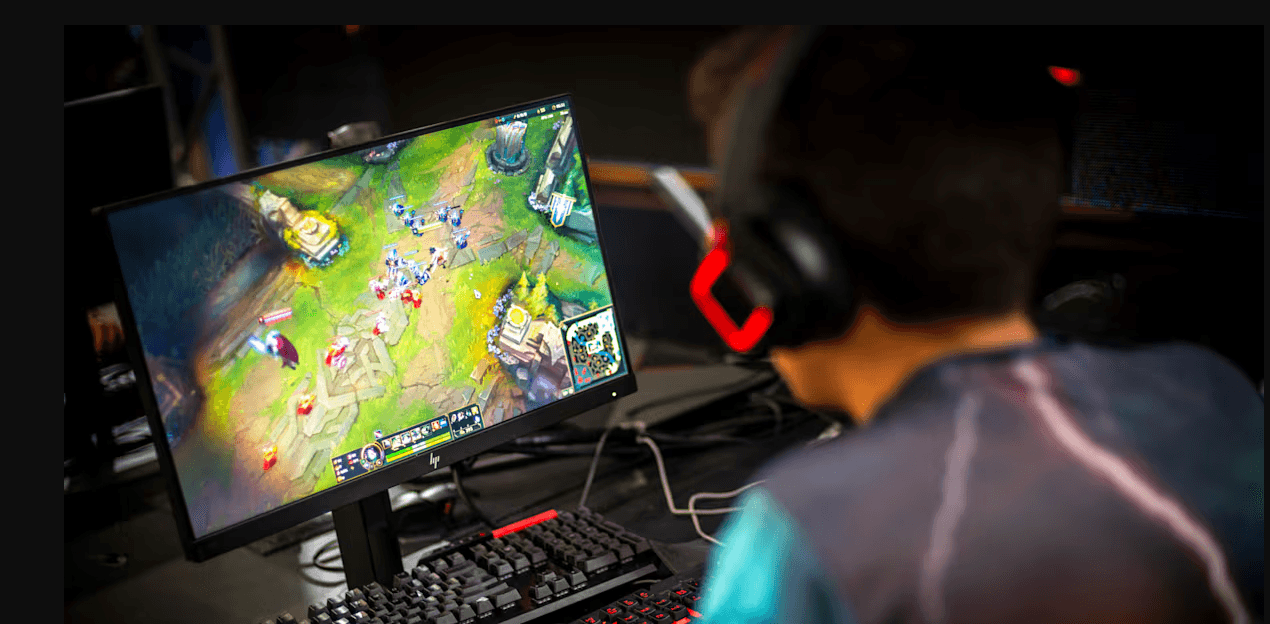
One of the most watched, most streamed, and most played competitive video games on the scene has just received its newest balance patch. League of Legends (LoL) was updated on April 15 with patch 26.8. It targets some of the champions that players, both casuals and pros, pick most often, and aims to change the meta a bit. This shakeup comes just in time for the newest seasonal split and could have huge implications for the rest of the year. As professional organizations get used to the seemingly small changes, LoL remains the MOBA to watch on streaming platforms. With online content creators playing it all the time, the game is yet to experience a fall in viewership.
For almost two decades now, the iconic title has been growing. It continues to go strong with millions of dollars on the line at the biggest tournaments and countless hours both watched and played. Be it a casual gamer who jumps into Summoners’ Rift with his mates, a ranked grinder who frequents the higher ranks each season, or a pro gamer or streamer whose career it is to be among the best lanes or junglers on the planet, LoL is for everyone. Therefore, when a new patch drops, the buzz does not die down for a while. That being said, we, too, analyze what the new update means for one of the biggest streaming titles and reveal why watching League of Legends Streams live on Kick is the number one option now.
Patch 26.8 Champion Nerfs and Buffs
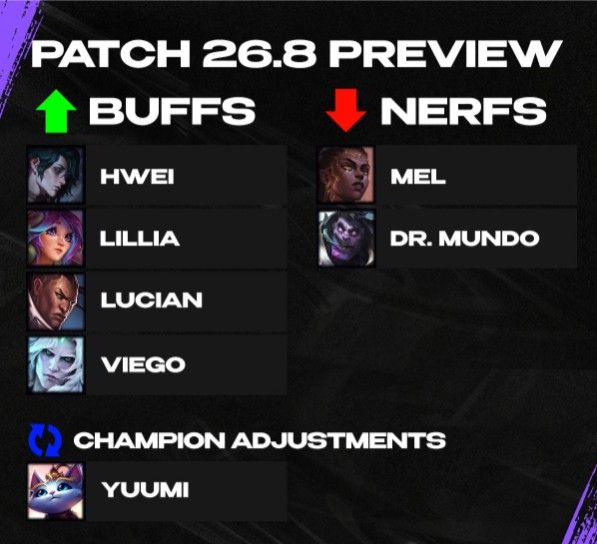
This patch is one of those small balance updates that target champions that are almost always picked, and those that are not as popular. Riot Games aimed to balance things out by making the favored pick a bit weaker or trickier, while improving certain others.
The Nerfs
On the nerf side, Patch 26.8 primarily targets champions that have been overly dominant or frustrating and trims their power in specific areas rather than issuing full scale reductions. Dr. Mundo’s jungle strength was directly hit by lowering the monster damage caps on his abilities, slowing his clear speed and delaying his scaling into a late game tank menace. Karma continues to be adjusted after previous patches failed to curb her strength, with reductions to base stats and increased mana costs on her shielding ability. This will force more deliberate usage and weaken her strong lane consistency.
Mel also received meaningful nerfs aimed at reducing frustration: her Q damage scaling and base values were lowered, while her W mobility window and cooldown were worsened, limiting both her poke and survivability. These changes collectively aim to tone down oppressive laning patterns and reduce reliability in both trading and escape scenarios. While not as numerous as buffs, the nerfs are more impactful in shaping gameplay, focusing on slowing tempo, reducing early dominance, and increasing counterplay opportunities across multiple roles.
The Buffs
Traditionally much more important and preferred by the player base, for obvious reasons, the 26.8 patch introduces a small but targeted set of buffs aimed at improving underperforming champions without dramatically shifting the meta. The most notable beneficiary is Hwei, whose passive damage was significantly increased, raising his late game ceiling and reinforcing his identity as a combo oriented mage rather than a waveclear bot. Riot also adjusted how his slows stack. This allows internal synergy while limiting abusive external stacking, keeping his power more controlled yet still rewarding in skilled play. Lucian received quality of life buffs to his mobility through reduced cooldown and mana cost on his E, making his early trading and repositioning more reliable in lane and skirmishes.
In a similar note, Lillia saw improvements to her jungle clear via a scaling increase to her passive’s monster damage cap, helping her regain tempo in the early game and making her more viable in current jungle rotations. Last but not least, Yuumi received compensatory buffs to her ultimate healing after bug fixes reduced unintended power, ensuring she remains a good competitive pick as an enchanter support. Overall, these buffs focus on smoothing gameplay and reinforcing intended champion identities rather than creating overt power spikes.
Watching League of Legends on Kick
The online streaming platform Kick has been more than a worthy opponent to the older, established platforms for quite some time. By now, it is going head to head with both Twitch and YouTube and is slowly but surely rivaling their top streamers while bringing many of the bigger names over. When League of Legends is concerned, there is a plethora of big names to follow, streamers who stream their gameplay daily and are arguably the best and most optimal way for the fans to see what Patch 26.8 has in store. Watching the pros do it will surely make the transition into the new meta easier. For example, BaianoTV on Kick is among the best on the entire platform for LoL.
Gustavo Gomes, better known by his online alias BaianoTV, is a Brazilian streamer and former League of Legends pro. He has built a large online presence through both competitive play and content creation and remains the go-to content creator for many LoL fans. He is notable for being one of the first Brazilian players to compete internationally, which helped establish his reputation in Latin America early in his career. After retiring from pro play, he transitioned into full time streaming and community building, founding projects like “Ilha das Lendas,” one of the largest Brazilian League of Legends communities focused on entertainment and discussion. On Kick, his channel has grown rapidly to over 213,000 followers, with strong engagement reflected in thousands of average viewers per stream.
On Kick, BaianoTV streams heavily and often broadcasts for long hours daily, sometimes exceeding 10 hours per session and averaging over 400 hours of airtime per month. Numbers like these show an extremely consistent and demanding schedule. His content primarily revolves around League of Legends, of course, including co streaming major leagues like LCK and LPL, analyzing professional matches, and hosting community driven events such as in house games and “CBOLÃO.” His streams mix entertainment with analysis, a combination that makes them appealing to both casual viewers and competitive fans. While he occasionally plays or explores other games, LoL remains the core of his content identity. His broadcasts frequently include live commentary, watch parties, and interaction heavy segments with chat, reinforced by custom systems like “Baicoins” that reward viewer participation.
LoL Streaming Advantages: Kick VS Twitch/YouTube
Since its earliest days in the competitive industry with established, tough to beat heavyweights, Kick has quickly positioned itself as a more creator friendly platform than Twitch and YouTube. This is especially true for League of Legends streamers who rely heavily on subscriptions and long form live content. The biggest advantage is its 95/5 revenue split, meaning streamers keep about 95% of the subscription income they get from their loyal fans, far higher than Twitch’s typical 50/50 or even 70/30 deals and YouTube’s roughly 70/30 structure.
This is not something that the competition can just flip over night. The split allows even mid sized LoL creators to earn significantly more with the same audience size. Kick also offers fewer intrusive ads and even provides hourly pay for some partnered streamers, giving financial stability that doesn’t depend entirely on viewer spikes. For LoL streamers grinding solo queue or co streaming pro matches, this model rewards consistency and time investment more directly than competing platforms. The most important thing is to simply show up and play every day. No caveats.
Another major advantage is discoverability and competition within the LoL category. On Twitch, LoL is one of the most saturated categories, dominated by massive creators and established esports personalities, as well as players who prefer other games but sometimes tune into League. This makes it hard for new streamers and hardcore Leaguers to stand out. Kick, by contrast, has fewer channels per category and allows smaller creators to be seen more easily and build an audience faster. This is particularly valuable for LoL streamers who rely on personality, chat interaction, and educational content rather than just raw gameplay skill, BaianoTV being the perfect example.
This is particularly valuable for LoL streamers who rely on personality, chat interaction, and educational content rather than just raw gameplay skill. Additionally, Kick allows more flexible content policies and multi streaming freedom, meaning creators can experiment with formats like co streaming LCK/LPL games, community in house, or variety content without as many restrictions or rules. The result is a less crowded, more experimental LoL streaming ecosystem compared to the rigid and highly competitive Twitch environment that feels more toxic, treacherous, and dishonest.
Finally, Kick’s growth has been accelerated by major creators moving to the platform, including xQc, who reportedly signed one of the largest deals in streaming history and now primarily broadcasts there. High profile names bring their audiences with them, which helps expand entire game categories like League of Legends on Kick. Other major creators, such as Adin Ross, Destiny, rapper Drake, and even Mr. Beast, have also contributed to the platform’s rapid rise and visibility.
LoL eSports Events 26.8 Will Affect
Patch 26.8 landed right in the middle of the 2026 competitive calendar, meaning its balance changes will directly influence ongoing regional splits and qualification races. The season itself began with the LCK, LEC, and LCS regional leagues in January, followed by multiple split phases throughout the year. When 26.8 arrived, teams were already deep into the Spring to Summer transition period, where results determine qualification for international play.
These patches are especially impactful because they can reshape priority picks, jungle paths, and team compositions just weeks before crucial playoffs. Since regional performance is the primary path to global events, even small buffs or nerfs can decide which teams adapt fastest and secure top placements. Hence, mid season patches like 26.8 are strategically significant across all major leagues.
Preparation for the Mid Season Invitational 2026 and the 2026 World Championship will be heavily affected. MSI 2026 takes place from late June to mid July in South Korea and serves as a meta defining tournament for the rest of the year. Worlds 2026, held from mid October to mid November in the United States, is the culmination of the season and will reflect whichever new meta stabilizes. Since teams scrim and practice on recent patches, any balance shifts can ripple through drafts, champion pools, and overall strategies heading into the most important tournaments of the year.
Most Popular LoL Players and Streamers
Why is Lee Sang-hyeok considered the greatest player in LoL history?
Faker’s unmatched consistency, multiple World Championship titles, and elite mechanical skill over more than a decade have cemented his legacy as the GOAT of LoL.
How did Jian Zihao become one of the most iconic ADC players?
Uzi’s aggressive playstyle, incredible laning dominance, and influence on the bot lane role earned him global respect, even without multiple Worlds wins.
What made Luka Perković unique compared to other pros?
Perkz is known for successfully role swapping between mid lane and ADC at the highest level, while leading teams with a strong personality and clutch performances.
Why is Rasmus Winther nicknamed “Baby Faker”?
Caps earned the nickname due to his explosive mechanics, carry potential, and making game changing plays similar to Faker in his prime.
How did Jang Jae-won redefine top lane carry potential?
Nuguri brought a hyper aggressive, resource heavy style to the top lane, proving it could be a primary carry role in professional play.
How did Yiliang Peng impact North America?
Doublelift became the face of NA LoL through domestic dominance, a strong personality, and long term influence on the region’s competitive scene.
Why is Søren Bjerg considered one of the best Western mid laners ever?
Bjergsen combined mechanical skill with leadership and consistency as he dominated North America for years, shaping the region’s competitive identity.
Michael Santana built a massive following after his pro career.
Imaqtpie transitioned into streaming with humor, relaxed gameplay, and strong community engagement, becoming one of Twitch’s most prominent LoL personalities.
What makes Tyler Steinkamp such an influential League streamer?
Tyler1’s high energy personality, redemption arc (after bans), and variety of ranked challenges helped him become a dominant figure in the LoL content creation scene.
What contributions in the LoL community are tied to Joedat Esfahani?
Voyboy became a respected voice advocating for better player behavior and game health, which in turn helped shape conversations around toxicity in the community.