
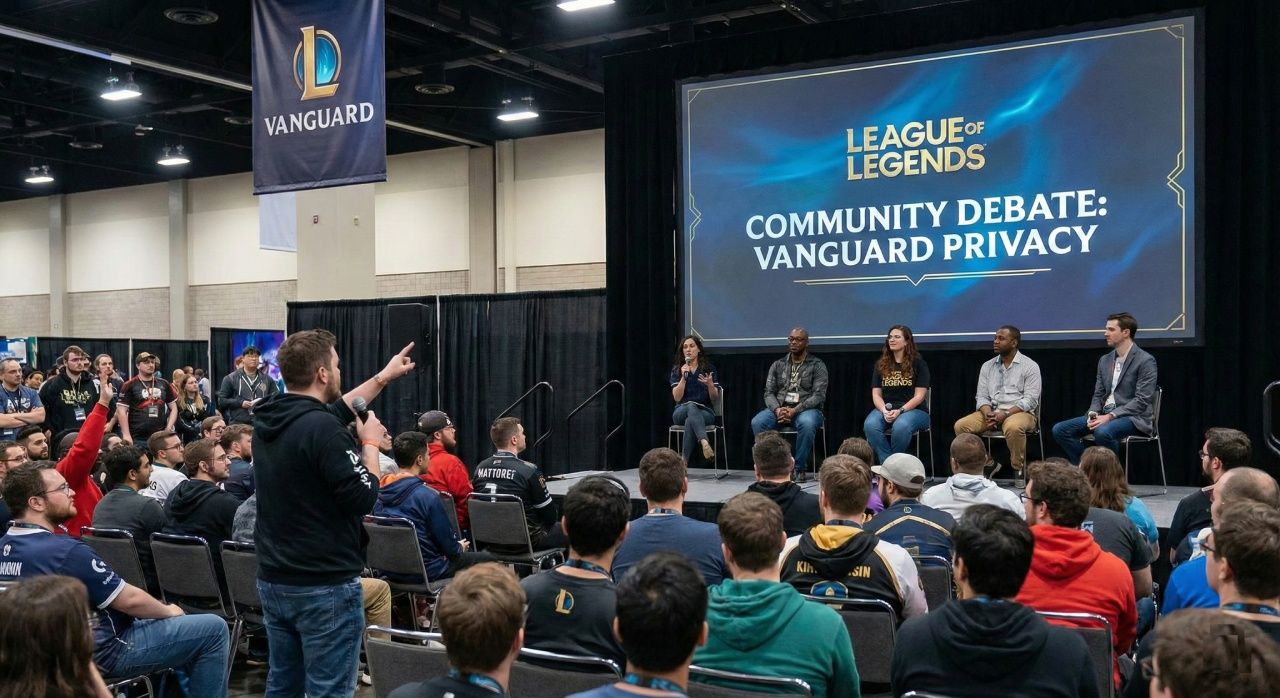
The integration of Vanguard into League of Legends changed how Riot Games approaches competitive integrity, completely altering the relationship between the developer and the player base. For years, the community clamored for a solution to the rampant scripting and botting that plagued the ranked ladder, undermining the accuracy of Matchmaking Ratings (MMR) and ruining the competitive experience. However, the introduction of a kernel-level anti-cheat system has ignited a complex debate regarding digital privacy, forcing players to weigh the value of a fair game against the potential risks of granting intrusive software access to their personal hardware.
This tension is not unique to League of Legends, but the sheer scale of the game's population makes it a critical case study for the entire gaming industry. As developers seek more concentrated methods to verify identity and skill, the technical requirements for playing have escalated, moving from simple client-side checks to deep system integration.
Vanguard Implementation Sparks Privacy Discussions Among Players
Vanguard's controversy in League of Legends stems from its status as a kernel-level anti-cheat driver, which operates at the deepest layer of your operating system (ring 0), granting it unprecedented access to monitor and intervene in nearly every process on your PC from boot-up. This is very different from something like using crypto at an online casino, for example. The interaction between player and operator stays confined to user-space applications, your browser or wallet app.
Several no KYC sites that you can read more on escapistmagazine.com, don’t require your name, personal docs, or email. You're pseudonymous, tied to a wallet address you control. You can spin up new wallets anytime, no loyalty enforced. Privacy is your choice via mixers/VPNs.These are sandboxed, limited in scope, and reversible by simply closing the tab, switching sites, or wiping your browser data.
With Vanguard, you're installing persistent system software akin to an antivirus or device driver that Riot controls, potentially exposing your entire machine to risks like crashes, driver conflicts, or, if exploited, full system compromise, all mandatory just to launch a free-to-play game. A crypto casino, on the other hand, only sees your funds, bets, IP address, and any KYC info you provide during gameplay.
It doesn't burrow into your OS kernel or demand reboots, so the trust is narrower (your money and privacy) rather than total control over your hardware. While both involve trusting a company, Riot for fair matchmaking, a casino for secure transactions, the kernel driver's "always-on" nature and potential for broad interference make Vanguard feel like handing over your house keys, whereas a casino is more like walking in with cash you can choose not to spend.
This discrepancy basically explains why players balk: LoL used to be lightweight and optional in its intrusiveness, but Vanguard trades that accessibility for aggressive cheating prevention, at the cost of your system's sovereignty.
Impact of Hardware Identification on Smurfing and MMR
The implementation of Vanguard has had real affects on the ranked ecosystem, particularly regarding the suppression of smurfing and boosting. By enforcing hardware identification (HWID) checks and requiring Trusted Platform Module (TPM) 2.0 compliance on Windows 11, the system makes it significantly more difficult for banned players to simply create a new account and return to the game.
In the past, a banned cheater could cycle through accounts with ease, but hardware bans now require changing physical components of the PC to bypass, raising the cost and effort required to cheat effectively.
This tightening of security has a direct positive correlation with the accuracy of the MMR system. Smurfs and boosters introduce artificial variance into matchmaking, causing games to feel unbalanced and making it difficult for legitimate players to climb to their true rank.
When a high-skill player boosts a low-skill account, or a cheater artificially inflates their rating, it disrupts the mathematical integrity of the ladder for everyone else in that lobby. By linking accounts more strictly to specific hardware configurations, Vanguard helps stabilize the player population, ensuring that a Gold-ranked player is actually playing at a Gold level.
The effectiveness of these measures is often measured by the "Time-to-Action," which refers to the number of games a cheater can ruin before being detected and removed. A faster detection cycle means fewer distorted matches and a cleaner dataset for the matchmaking algorithm.
While some players feel the hardware requirements are exclusionary or invasive, the resulting stability in ranked play offers a compelling argument for those who prioritize competitive fairness above all else. The reduction in disposable accounts forces players to value their primary accounts more, theoretically leading to better behavior and a healthier competitive environment.
Contrasting Esports Security with Privacy Trends in Other Sectors
The move toward stricter identification is justified by the zero-sum nature of competitive play, where one person's gain is another's loss. To maintain trust, Riot has had to clarify the limits of their surveillance.
Riot's security teams have clarified that Vanguard does not collect personal information beyond standard anti-cheat requirements, emphasizing that the data is used solely to verify system integrity and is not retained indefinitely. This difference is crucial for players who might be comfortable with anti-cheat measures but would balk at their data being used for marketing or behavioral profiling.
The comparison with other sectors highlights that the "Vanguard model" is not the only way to manage digital communities, but it may be the only effective way to manage competitive ones. In environments where financial transactions or personal data are the primary assets, privacy-preserving technologies like zero-knowledge proofs are gaining traction. However, in a high-speed gaming environment where milliseconds matter, the computational overhead of such privacy tools is currently impractical. Consequently, gamers are left in a unique position where their hobby requires a level of surveillance that would be considered excessive in almost any other non-secure context.
Future of Identity Verification in Competitive Online Gaming
The ongoing battle between cheat developers and security teams suggests identity verification in competitive gaming will only intensify. Recent updates to Riot’s Vanguard anti-cheat system have focused on closing the “pre-boot gap,” preventing cheats from loading before operating system protections activate. Retrospectives indicate these measures have reduced response times against offenders, reinforcing the belief that deeper system access improves competitive integrity.
As cheating methods grow more advanced, including external hardware exploits and AI-assisted tools, anti-cheat systems are likely to integrate even more tightly with operating systems and hardware. This trajectory points toward verified matchmaking environments that may require biometric confirmation or government-issued identification, similar to frameworks tested in South Korea.
Such systems could dramatically reduce smurfing and high-level cheating, but they would also further erode anonymity in online play. The player base is likely to remain divided: casual competitors may resist increased surveillance, while serious players may accept it as the price of fair competition.
The broader issue extends beyond one anti-cheat program. As esports continues to professionalize, informal online identities are giving way to regulated ecosystems. The challenge ahead is maintaining competitive integrity without allowing privacy costs to escalate unchecked, a balance that will define the next phase of online gaming.