League of Legends ranked represents the pinnacle of competitiveness, offering the most skill-intensive way of playing the game.
For this reason, it has been the most popular method of playing the game ever since its initial inception.
However, navigating the complex League of Legends ranked system can be extremely confusing, especially if you’re a new player trying to embark on your first ranked journey.
With its intricacies and complexities, understanding how the ranked system works is crucial to your long-term progress as a player and increases your likelihood of climbing.
Which ranks are there?
Ranked tiers breakdown
| Rank | Division | Player distribution | Total distribution |
|---|---|---|---|
| Challenger | Apex ranks have only one division | 0.022% | 0.022% |
| GrandMaster | Apex ranks have only one division | 0.052% | 0.052% |
| Master | Apex ranks have only one division | 0.65% | 0.65% |
| Diamond | Diamond I Diamond II Diamond III Diamond IV | 0.49 % 0.63 % 0.88 % 2.0 % | 4% |
| Emerald | Emerald I Emerald II Emerald III Emerald IV | 2.2% 2.0% 3.0% 6.1% | 13% |
| Platinum | Platinum I Platinum II Platinum III Platinum IV | 3.0% 4.0% 4.6% 7.0% | 18% |
| Gold | Gold I Gold II Gold III Gold IV | 3.8% 4.4% 4.5% 6.2% | 19% |
| Silver | Silver I Silver II Silver III Silver IV | 3.4% 4.1% 4.4% 5.5% | 17% |
| Bronze | Bronze I Bronze II Bronze III Bronze IV | 3.7% 4.4% 4.6% 5.2% | 18% |
| Iron | Iron I Iron II Iron III Iron IV | 3.0% 2.4% 1.4% 1.0% | 8% |
The League of Legends ranks are distributed in 10 unique tiers, each further divided into four divisions, except the Apex tiers.
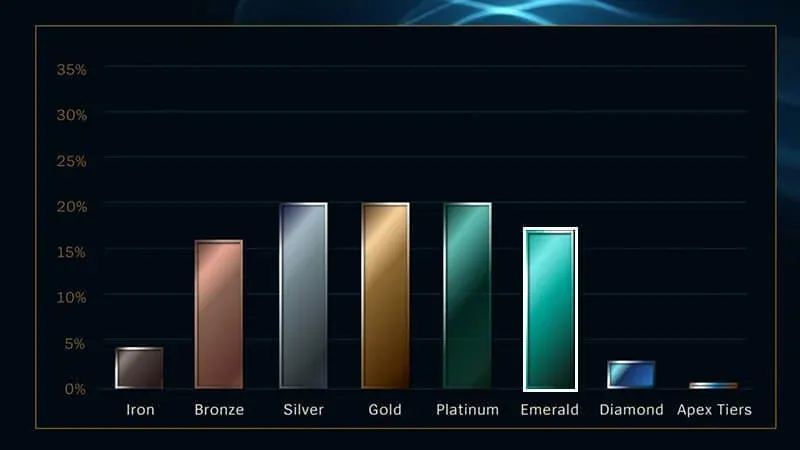
Statistically speaking, the majority of League’s player base is ranked between Bronze and Emerald, with Gold being the average tier overall.
This ranked structure serves as the primary way of determining a player’s skill level and overall progression within the game’s ranked ladder.
Since players want to climb and improve, games are generally approached seriously, with a competitive mindset.
What is Elo?
In League of Legends, talking about ranked goes hand in hand with elo, which is another method of describing the ranked matchmaking ladder.
Initially used to assign numerical values to skill levels in chess, this method in League is often used to evaluate a player’s skill level as well.
Low elo players are considered those ranked between Iron and Silver, often displaying a generally low level of skill, particularly in the mechanical and macro departments.
That being said, the difference between low Iron and high Silver is astronomic, with low Iron players often being completely bereft of the most fundamental League of Legends skills.
Average elos are those between Gold and Emerald, hosting an abundance of decent League players with a solid mechanical platform with plenty of room for improvement.
At the top of the pyramid are the high elo LoL ranks, including Diamond and Apex tiers which amount to the top 5% of players on any server.
Among those, only the best 1% ever enter the Apex tiers, which is only a testament to the incredible skill level and in-game proficiency of Master+ players.
How LoL ranked works
Ranked queues
League of Legends ranked queues are divided into two separate game modes, each differing in gameplay style, ruleset, and competitive structure.
Solo/duo queue
Much like the name suggests, the solo/duo queue is designed for individual players who want to compete at the highest level and test out their skills against other competitive players.
Solo queue refers to queuing up on your own, playing in a lobby full of other solo/duo players that are relatively similar to your current rank.
This is the most common method of playing ranked unless you have a duo partner who you’re consistently playing with.
Duo queue enables you to match up with a duo partner of your choice before entering the ranked matchmaking system, allowing you to approach the match as a cohesive unit.
Most commonly, duo partnerships are forged between bot lane partners or solo laners and junglers.
Solo/duo is focused heavily on individual performance and outplays, while also requiring a great level of team cohesion combined with strategic macro decision-making.
Generally speaking, solo queue is considered the ultimate benchmark and testament of a player’s League of Legends skills, which is why the majority of the player base tends to take this queue seriously.
Ranked flex
Ranked flex is the complete opposite of the League of Legends rank solo/duo experience, as this game mode allows you to queue up with your friends and play as a pre-made team, instead of a single duo partner.
This enables teams of varying sizes, ranging from two to five players, to embark on a ranked experience that is more oriented towards team play rather than individual prowess.
Even though flex has a ranked ladder like the solo queue, players are less likely to tryhard while playing flex games as the game mode is generally more light-hearted and casual.
LP and ranked progression
In ranked queues, you can reach the next League of Legends rank in order by amassing enough LP (League Points). Winning a League ranked match grants you a certain amount of LP, contributing to your advancement within your current tier.
Reaching 100 LP in a certain rank triggers a promotion, instantly promoting you to the next ranked division in order.

On the other hand, losing a League of Legends ranked match will result in an LP deduction, which can potentially endanger your current rank and lead to demotion.
If you lose several matches while being at 0 LP in a certain rank, you will be demoted to the lower division.
Ranked season and split
In League of Legends ranked, annual seasons take place that are divided into separate splits, with the intent to provide a consistently fresh and challenging ranked experience.
As it currently stands, splits refresh thrice per year, in January, May, and September, with each split refreshing the ranked ladder as players reset their rank and play a new set of placement matches.
With each refresh, you also receive ranked rewards allocated for the current split that are relative to your ranked achievements.
Placement games
Placement games are the method Riot uses to determine your starting rank in the current season or split.
Before you get placed into a League of Legends rank, you must complete 5 placement games where your win rate, performance, and previous rank affect your starting division and tier.
You will only play these games if you’re currently Unranked, which happens if you’re only playing ranked for the first time overall or if you haven’t played during this split/season.
While playing placement matches, you cannot lose LP in any way, resulting in a +0 when you suffer a placement loss.
On the other hand, winning these matches is particularly important as these wins are usually much more rewarding in terms of LP than regular ranked wins.
It’s also worth noting that the highest League rank you can theoretically achieve from initial placement games is Platinum I.
Rank decay
Decay is a measure that ensures high elo players who are Diamond and above actively play and participate in League of Legends ranked.
Effectively, it punishes players who don’t play for extended periods, automatically deducting LP if a player fails to participate in a ranked match within a certain time frame.
Consequently, there is little to no stagnation when it comes to high elo brackets, especially the Apex League ranks, as they adhere to the harshest decay rules.
Ranked queue restrictions
Duo queue restrictions
These duo queue restrictions aim to balance the matchmaking process and match two teams with similar ranks across the board.
This is because duo partners with largely differing ranks (eg. Silver III and Emerald II duo) would create unbalanced matchups and teams across the Rift.
Furthermore, it is meant to curb the power of duo queueing, especially in high elo where it can create an unfair advantage.
| Your rank | Who you can duo with |
|---|---|
| Challenger | Solo only |
| GrandMaster | Solo only |
| Master | Solo only |
| Diamond | 2 divisions higher/lower |
| Emerald | Platinum or Diamond up to 2 divs higher |
| Platinum | Gold - Emerald |
| Gold | Silver - Platinum |
| Silver | Iron - Gold |
| Bronze | Iron - Silver |
| Iron | Iron - Silver |
Flex queue restrictions
Since flex queue is meant to represent a somewhat casual ranked experience, there aren’t any restrictions in place when it comes to playing with non-Apex tier players.
This means that you can queue up with anyone on your friend list, resulting in an inclusive environment where players with varying skill levels can compete without limits.
The only restrictions in place regard Master tier+ players, in which the lowest-ranked member of the lobby has to be Emerald or higher.
When can I start playing ranked?
There are only two requirements that your account must fulfill before it’s eligible to participate in ranked matches:
Level 30 or above
Over 20 champions unlocked
These requirements are set in place to ensure that players entering LoL ranked play for the first time have a certain level of experience and familiarity with the game.
Bear in mind that even if you have both of these requirements fulfilled, it’s best to meticulously prepare before jumping into ranked play.
Mastering a few champions and understanding the game’s mechanics before playing your initial placement matches will go a long way in benefitting your long-term League of Legends rank and MMR.
What are ranked rewards?

Victorious skin and chromas
Victorious skins are the most prestigious and covetable ranked rewards as they symbolize a player’s skill and dedication to climbing League of Legends ranks.
These skins are unlockable by amassing 1000 split points in a specific split if you’re ranked Silver or below, whereas Gold ranks and above only need 80 split points alongside their current rank.
On top of getting that split’s Victorious skin, if you’re ranked Gold or above, you can also get a Chroma whose appearance corresponds to your end-of-split ranked division.
Summoner Icons, crests, and borders
Apart from skins, ranked rewards are also present in the form of summoner icons and decorative Regalia.
Summoner icons are distributed at the end of the ranked season and they are awarded for both flex and solo queue and their appearance matches the player’s end-of-season rank.
Decorative League of Legends ranked Regalia is present in two forms, those being Crests and Borders.
Summoner Crests are indicative of your current rank and they’re visible on your Summoner profile page.
You can also use your current rank crest to decorate the outline of your summoner icon.
Ranked borders are displayed on the loading screen, where their appearance is relative to your rank in a specific queue.
That means you’ll have a separate loading border for both flex and solo queue, as well as your normal games.
Ranked split rewards
Riot rewards you for long-term commitment to League of Legends ranked by frequently rewarding you with cosmetic rewards at certain SP (split point) checkpoints. Rewards at these checkpoints include several valuable items:
Hextech crafting items (chests, keys, key fragments, and orange essence)
Mystery emotes and split-specific emotes
Champion permanents
Summoner icons
Related Articles: